
You’re driving to the grocery store—window down, your favorite song on the radio. It’s one of those good days where life just feels easy. Then suddenly, flashing blue lights fill your rearview mirror. Your stomach drops, your pulse quickens. What did you do? Are you in trouble? A hundred thoughts race through your head as you reach for the turn signal and look for a place to pull over.
In that moment, what you do next can determine whether this ends as a quick traffic stop with at best, a warning, at worst, a ticket, or something far worse, such as arrest and felonies, as more traffic stops caught by police cameras show on social media. There’s no need for any traffic stop to go viral. Here’s how to handle police encounters calmly, lawfully, and in a way that protects your rights.
Pulled Over in a Vehicle
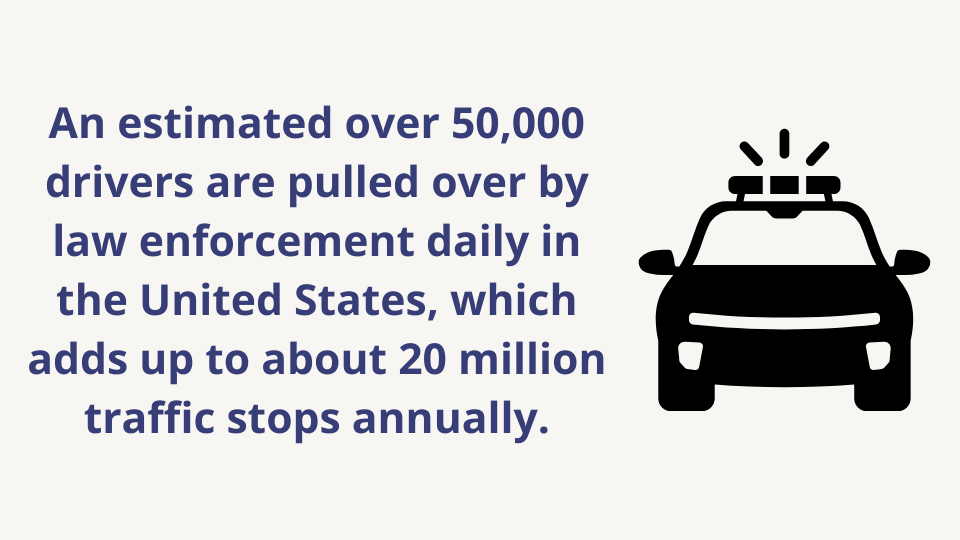
Getting stopped by police while driving is the most common encounter citizens have with law enforcement. A little preparation and a clear plan can keep the situation from escalating and protect your rights.
When you see the lights, slow down and signal immediately to show you are complying. Pull over as soon as it is safe, preferably onto the right shoulder or into a well-lit parking area. At night, turning on your dome light lets the officer see clearly inside your car and puts them at ease. A jokingly common saying among married couples is, “Happy wife, happy life.” Well, putting it into similar terms, “Relaxed cop, easier stop,” is something every citizen should strive for on every police encounter.
Remember, as an officer approaches your car, he has no idea whether you are the church-going salutatorian of your school or a two-time felon willing to do anything to avoid that third strike. Put their mind at ease as early in the encounter as possible, and whether you get a ticket or not, the stop should go much easier. You can always fight the ticket in court if you feel it was unwarranted.
Once stopped, follow this order of actions:
- Stay inside the vehicle. Turn off the engine. Roll down your driver’s window.
- Keep your hands visible. Place them on top of the steering wheel where the officer can see them.
- Wait for instructions. Don’t reach for your license, registration, or glove box until the officer asks. Sudden movements can be misinterpreted as somebody going for a weapon.
- Be respectful and calm. Address the officer politely. Getting argumentative or sarcastic has helped nobody, ever in this situation. Your odds of being the first are not very likely.
- Provide what is legally required. You must give your driver’s license, registration, and proof of insurance when asked. Not providing this makes it likely you will receive additional charges to anything he or she originally pulled you for.
- If armed, follow your state’s law. In duty-to-inform states like Michigan, North Carolina, and Texas, you must immediately tell the officer you are carrying a firearm and where it is located before reaching for anything. Say something calm like, “Officer, I have a valid carry permit and I am carrying on my right hip.” Then wait for instructions before moving. Even in states that don’t require you to inform the officer, if your gun is in a console or glove box where you have your wallet or registration, it’s a good idea to inform the officer so he doesn’t see the gun and mistake your actions. If you carry a firearm, know the gun laws in your state.
- If the officer issues you a ticket, accept it without argument. You can fight it later in court if you choose, but roadside is not the place for a debate.
Remember: you are not legally required to answer questions like where you’re going or where you’ve been. Politely declining to answer beyond the required information is your right, and you should calmly exercise it if you prefer not to engage in small talk. Many attorneys advise to never admit to any illegal conduct. When asked, “Do you know why I stopped you?” a simple, “No sir” or “No mam” will suffice. In fact, small talk and trying to explain things often gets a person in more trouble, so attorneys suggest being respectful in doing what’s required, but politely declining from engaging in discussion.
Sometimes, a police officer may ask if they can search your vehicle. The Fourth Amendment of the Constitution states:
The right of the people to be secure in their persons, houses, papers, and effects, against unreasonable searches and seizures, shall not be violated, and no Warrants shall issue but upon probable cause, supported by Oath or affirmation, and particularly describing the place to be searched, and the persons or things to be seized.
Over the years and since the advent of the automobile, that protection has been largely extended to vehicles. Fairfax, Virginia, attorney Wilfred W. Yeargan advises, “If the officer asks something like, “Do you mind if I look through your vehicle?” simply reply with, “No, sir, I don’t consent to the search.”
Now expect such a refusal to irk the officer and turn the stop into a more hostile encounter but barring any probable cause such as an open container of alcohol in the drink holder, the smell of marijuana wafting from inside the car, or the butt of a handgun sticking out from under a seat, you do not have to consent to a search. However, if the officer does have probable cause, at that point, he can legally search your vehicle with or without your consent and arguing or attempting to stop him will virtually guarantee you are going to jail or going to jail with additional charges.
Keep Calm, Remain Respectful at All Times
Lawyers and civil rights groups agree: remaining calm, visible, and respectful during a police encounter is the best way to protect yourself. You are not required to provide more information than the law compels you to give, and anything you say can be used against you later. That’s why attorneys stress the importance of saying as little as possible until you have had time to calm down and, if necessary, consult legal counsel.
If the situation becomes serious—especially if you have used force in self-defense—state clearly, “I want to remain silent and speak to an attorney.” Federal case law requires you to invoke this right out loud. Then stop talking. Even police officers are given time before making a statement after a shooting; you deserve the same consideration.
Remember that refusing to answer questions or declining a search is not an admission of guilt. It is your constitutional right. Former Pinal County (Arizona) Sheriff Mark Lamb once put it plainly: “Be polite with your interaction with law enforcement, but do not hesitate to exercise your constitutional right and the 5th Amendment.”
Written by: Doug Howlett
📚 References & Further Reading:
USLawShield. (n.d.). Duty-to-inform laws: Do they apply to you? USLawShield. https://www.uslawshield.com/duty-to-inform-laws-do-they-apply-to-you/
USLawShield. (n.d.). Guns laws. USLawShield. https://gunlaws.uslawshield.com/
USLawShield. (2018, January 3). Self-defense booklet. USLawShield. https://www.uslawshield.com/wp-content/uploads/2018/01/03_SSBooklet.pdf
Justia. (n.d.). The Fourth Amendment – Vehicular searches. Justia. https://law.justia.com/constitution/us/amendment-04/16-vehicular-searches.html
Yeargan Law. (n.d.). Do I have to let the police search my car? Yeargan Law. https://www.yearganlaw.com/do-i-have-to-let-the-police-search-my-car.html