It’s a normal day at school—you’re walking to class, maybe chatting with friends, when suddenly a campus officer calls out and tells you to stop. Your stomach tightens, your pulse jumps. Did you do something wrong? Are you in trouble? In that moment, what you do next can make the difference between a calm interaction and an encounter that escalates unnecessarily. Here’s how to handle a stop on school property while protecting your rights.
Stopped on a School Campus
Being stopped by police or security on school property can feel intimidating, but staying calm and knowing your rights helps keep things under control. Stop immediately when directed, face the officer, and keep your hands visible. Campus police are most often sworn officers, not security guards, and they have the same authority as county deputies, city police, and possibly even state police.
Have your student ID ready if asked (or if not a student on campus, your regular ID). Campus police can ask you to identify yourself, but you have the right to remain silent beyond providing basic identification.
You do not have to answer questions about where you’ve been, what you were doing, or who you were with. If an officer starts asking questions, you can politely say, “I choose to remain silent,” which invokes your constitutional right (Fifth Amendment) to avoid self-incrimination.
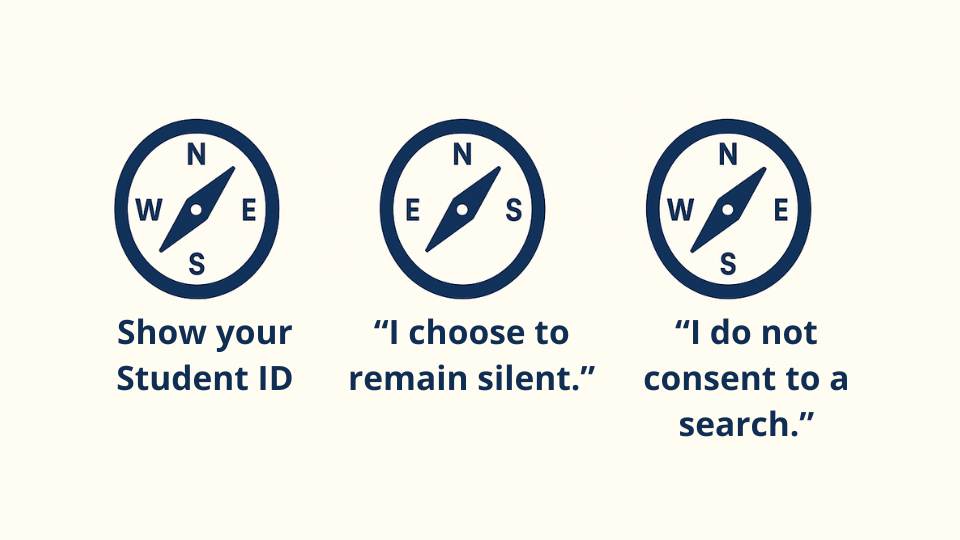
If asked to write or sign a statement, you may refuse until a parent, guardian, or attorney is present. If the officer asks to search your backpack, locker, or personal belongings, you can clearly state, “I do not consent to a search.” This may not stop the search, but it preserves your rights if the search is later challenged in court. Campus police or administrators also cannot search your dorm room without a warrant or your consent, so your same rights apply there.
If you are told you are not free to leave, stay calm and do not resist, argue, or run. Clearly say, “I wish to remain silent and I want a lawyer.” In some states, even if over 18, you can still ask for a parent to be present as well, which will stop the questioning until they are there. Never sign or agree to anything until you’ve had legal advice from a licensed attorney.
When it comes to gun owners, the laws get more serious. For those who lawfully carry firearms, keep in mind that federal law prohibits having a loaded gun within 1,000 feet of a K-12 school unless you have a permit issued by that state. Even then, it doesn’t allow you to take it inside buildings. Meanwhile, many college campuses, either through state law or school policy supported by state law, forbid the outright possession of firearms on your person or in vehicles while on college property, including residential housing and sporting facilities.
If you are stopped while carrying, follow any state duty-to-inform laws, comply with officer instructions, and contact your attorney as soon as possible.
Keep Calm, Remain Respectful at All Times
Lawyers and civil rights groups agree: remaining calm, visible, and respectful during a police encounter is the best way to protect yourself. You are not required to provide more information than the law compels you to give, and anything you say can be used against you later. That’s why attorneys stress the importance of saying as little as possible until you have had time to calm down and, if necessary, consult legal counsel.
If the situation becomes serious—especially if you have used force in self-defense—state clearly, “I want to remain silent and speak to an attorney.” Federal case law requires you to invoke this right out loud. Then stop talking. Even police officers are given time before making a statement after a shooting; you deserve the same consideration.
Remember that refusing to answer questions or declining a search is not an admission of guilt. It is your constitutional right. Former Pinal County (Arizona) Sheriff Mark Lamb once put it plainly: “Be polite with your interaction with law enforcement, but do not hesitate to exercise your constitutional right and the 5th Amendment.”
Written by: Doug Howlett
📚 References & Further Reading:
American Civil Liberties Union. (n.d.). Know your rights: Students’ rights. ACLU. https://www.aclu.org/know-your-rights/students-rights
FindLaw. (n.d.). Are campus police the same as real police? FindLaw. https://www.findlaw.com/legalblogs/criminal-defense/are-campus-police-the-same-as-real-police/
Cornell Law School. (n.d.). Fifth Amendment. Cornell Law School Legal Information Institute. https://www.law.cornell.edu/wex/fifth_amendment
2A Institute. (n.d.). Campus carry: Are guns allowed at your college? 2A Institute. https://www.2ainstitute.com/campus-carry-are-guns-allowed-at-your-college/